Lizzy's Mother Dies and Is Buried on the Santa Fe Trail
The StaircaseMama’s death and burial on the Santa Fe Trail establish the loss that shadows Lizzy Enders’s journey: her mother dies of a putrid fever in a landscape she had experienced as limitless, and Lizzy watches her laid in a grave beneath the changing western sky. The burial is both a practical response to death on the road and an intimate rupture, witnessed by a child who can perform the expected farewell but cannot find her mother in the body beneath the buffalo robe.
Illness and the Vast Country
In her final days, Mama lay feverish in the wagon as the family traveled. The country’s starkness troubled her; its apparent boundlessness gave ordinary travel the scale of an existential ordeal. She told Lizzy, “There is no end to it, Lizzy,” and called it “eternity.” In the narrative, this is not an abstract fear detached from circumstance: illness, the exposure of the journey, and the immense landscape converge in Mama’s own perception of what lies ahead.
At night, Lizzy heard her mother whimper when a coyote howled. On another occasion, as they passed an unmoving man wrapped in a blanket in front of a pueblo, Mama clutched Lizzy’s hand and said, “He’s waiting for me, Lizzy.” The moment connects her fear of the country with an apprehension of death. The next day she died of the putrid fever. Her death is stated plainly, but the preceding images give it a mounting presence: the night sound, the still figure, and Mama’s conviction that something was waiting for her.
Mama’s history also gives the journey a family context. She came from Georgia, a place Lizzy remembers through the image of days that felt like being bathed in milk. The family’s past includes the war that took Daddy’s arm at the Battle of Buzzard Roost Gap, and the move to Independence, Missouri, where Mama’s family sheltered her. Lizzy’s account says that this shelter nearly squeezed the life out of Daddy. Against those earlier places and upheavals, the trail becomes the setting for another irreversible change: Mama dies while the family is in transit, far from the familiar home that had once sheltered her.
The Burial at Dusk
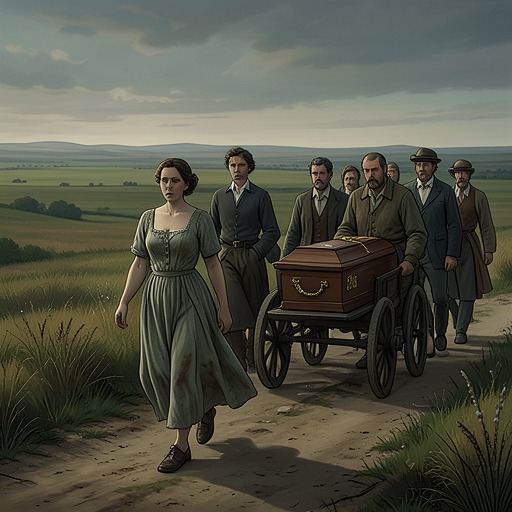
Mr. French digs the grave while the country seems to resist him. Lizzy hears the soft thud of his work and feels that sound has little force in such an immense place; even the family’s voices seem impossible to measure against it. The surrounding landscape makes the mourners feel insignificant, while distant mountains offer the only sense of scale. Aspens gild the peaks as the sky darkens, and the scene holds contradictory light: darkness arrives quickly, yet some western mountain tops still appear lit as if by midday.
Mr. French and Daddy lift the buffalo robe containing Mama and lower it into the grave. A coyote wails in the distance. Daddy directs Lizzy to say goodbye, while Elinora reads from her Bible. Lizzy would rather hear the coyote; its howl seems more fitting to her than the words being read. The difference is not simply between religious observance and irreverence. The ritual offers the family a recognizable form for the burial, but Lizzy registers the surrounding land and its animal sound as truer to the desolation she feels.
Lizzy stands respectfully for a moment, yet she cannot feel that Mama is present inside the robe. Her understanding is stark: her mother is already gone from the place. She wishes she could be gone too. When the burial is over, she turns, as she knows she must, and helps Mrs. French and Mrs. Wade with supper. The movement from grave to household duty gives the scene its unsentimental ending. Grief has not been resolved; the living must continue with the immediate work of the evening.
The Loss in Lizzy’s Later Life
The burial remains more than a single scene in Lizzy’s memory. At school, evening prayers in the chapel become the time she allows herself to think about Mama. She recalls that the incense, Latin, and responses bring a sense of peace, or at least room to sort things out. During the day, thoughts of her mother arise in ordinary moments: Lizzy imagines telling her something or wonders what Mama would think. These recurring inward conversations show how bereavement persists after the practical demands of the journey have carried Lizzy onward.
The burial also clarifies the difference between physical presence and remembered attachment. At the grave, Lizzy cannot locate her mother in the body wrapped in the buffalo robe; later, she continues to address Mama in her thoughts. The narrative therefore presents grief not as a single declaration of sorrow but as a changing relation to absence. The dead body belongs to the grave and the trail, while the mother remains part of Lizzy’s private judgments, discoveries, and imagined confidences.
Narrative Significance
The event joins a child’s immediate perception to the larger emotional conditions of travel: a feverish mother, an exposed grave, failing daylight, and a family required to proceed. Its spare physical actions—digging, lowering the robe, listening to the coyote, turning toward supper—make the loss concrete without suggesting that a ceremony can make it bearable. Lizzy’s distance from the Bible reading and her sense that Mama has already left the place preserve the uncertainty of a child confronting death rather than supplying a consoling resolution.
The landscape is central to that effect. For Mama, its unending reach had become an image of eternity and a source of dread; for Lizzy, it magnifies the mourners’ smallness and makes their voices seem insufficient. Yet the scene does not leave her only in that vastness. The later return of thoughts about Mama shows that memory creates a continuing bond where the burial marks a physical separation. The event thus sets the terms for Lizzy’s grief: death is final in the world of the journey, but her mother remains present in the life Lizzy continues to interpret and imagine.